
Intentional Goal Setting Creates Clarity and Direction for Long-term Growth
- wokolako

- Jan 22
- 6 min read
Updated: Feb 27

In today’s rapidly evolving job market, career success rarely happens by accident. Roles are changing, new skills are constantly emerging, and traditional career paths are becoming less predictable.
For early-to-mid-career professionals, job seekers, and career changers, this environment can feel overwhelming. One of the most effective ways to regain clarity and control is by setting clear, well-structured career goals.
The Importance of Career Goals
Career goals serve as a personal guide in a competitive and uncertain employment landscape. Without them, professionals often drift from role to role, reacting to opportunities rather than making intentional choices.
In modern workplaces, where continuous learning and adaptability are essential, career goals act as an anchor. They allow you to evaluate whether a role, a project, or a skill aligns with your long-term direction instead of being distracted by short-term pressures.
Many professionals have goals such as “I want to advance in my career,” “I want a better-paying job,” or “I want to be successful.” While these goals reflect ambition, they rarely lead to sustained action.
Guidance from goal-setting literature consistently shows that vague goals make it difficult to know what to do next or how to evaluate progress. This is because vague goals lack:
Clear Definition: Broad statements don't give you enough guidance to make decisions or plan actions. Without clarity, you can't tell which opportunities fit your goals or which skills you need to develop.
Ways to Measure Progress: Unclear goals give you no way to track progress or know when you've succeeded. Without feedback, it's hard to stay motivated or fix strategies that aren't working.
Deadlines: Goals without time limits create endless timelines that reduce urgency and make it easy to procrastinate. Without deadlines, there's no accountability, and other priorities will always seem more important than career development.
In the absence of a clear structure, goals often become wishful thinking, with minimal progress achieved. When inevitable challenges arise during execution, such as resource limitations or workload pressures, the lack of a concrete plan makes it significantly easier to abandon the goal altogether than to forge through.
The SMART Framework: Turning Goals into Action

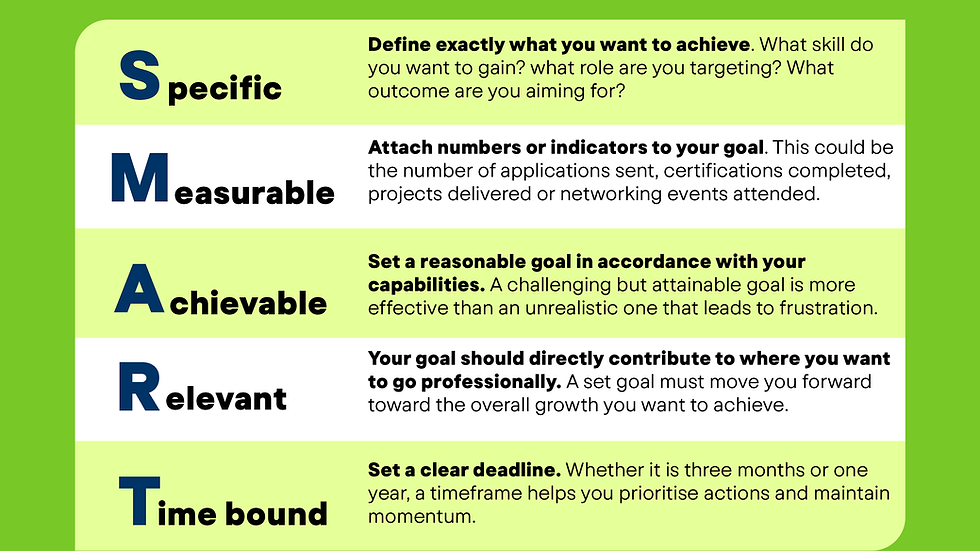
The SMART method transforms vague career wishes into clear, practical plans using five key criteria. This approach, used widely across industries and proven effective over decades, gives professionals a simple system for creating goals that actually work.
1. Specific (Define Exactly What You Want to Achieve)
Being specific means stating exactly what you want to accomplish. Instead of "improve my leadership skills," a specific goal would be "learn how to lead cross-functional team meetings and resolve conflicts between team members."
Specific goals answer these basic questions:
What exactly will I achieve?
Why does it matter?
Who's involved?
Where will this happen?
What resources or obstacles are relevant?
Example: Instead of "get promoted," say "get promoted to Senior Product Manager with team management responsibilities in the enterprise software division."
2. Measurable (Set Clear Ways to Track Progress)
Making goals measurable means creating objective ways to assess your progress and know when you've finished.
Tracking your advancement helps you stay on course, spot when you need to make changes, and clearly recognize when you've achieved your goal.
Good measurement criteria include numbers, completed milestones, earned certifications, performance scores, or other concrete indicators.
Example: "Complete three data analytics certifications (Python, SQL, Tableau), use these skills on at least two client projects, and receive feedback ratings above 4.5 out of 5 from stakeholders."
3. Achievable (Balancing Challenge with Reality)
Achievable goals push you to grow without becoming impossible to reach. This means honestly evaluating your current skills, available resources, time constraints, and external factors that affect what's realistic.
Goals should challenge you to step outside your comfort zone while staying grounded in reality. Goals that are too ambitious lead to discouragement through repeated failure, while goals that are too easy don't drive meaningful growth.
Consider your existing commitments, how much you can learn, opportunities in your organization, and market conditions when deciding if a goal is achievable.
Example: For a mid-level manager, "become Vice President in six months" is probably unrealistic, but "position myself as a strong candidate for Director-level roles within 18 months through focused skill development and leading big projects" is appropriately challenging.
4. Relevant (Align Your Goals with Your Long-Term Vision)
Relevant goals support your bigger career plans and personal values. This ensures you don't pursue objectives that, while potentially achievable, don't actually help you get where you want to go.
To check if a goal is relevant, think about your long-term career vision, industry trends, your organization's direction, and your personal priorities. Your goals should move you toward your ultimate career destination, not distract you or lead you off track.
For instance, if you want to move into strategic consulting, getting an advanced technical certification in software development might not be very relevant.
However, developing skills in business strategy, client relationship management, and industry analysis directly supports this career direction.
5. Time-Bound (Set Specific Deadlines)
Time-bound goals include specific deadlines that create urgency, enable planning, and provide accountability.
Clear timeframes prevent you from putting things off indefinitely and help you create detailed action plans with steps along the way.
Good deadlines give you enough time to do quality work while maintaining momentum. Setting checkpoints within long-term goals keeps you engaged and helps you spot obstacles early so you can adjust your strategy.
Example: Within the next twelve months, move from individual contributor to team lead by: finishing the leadership development program by the end of Q2, leading two cross-functional projects by the end of Q3, and getting a formal recommendation from my current supervisor by the end of Q4.
How to Create Effective SMART Career Goals
Turning career wishes into effective SMART goals requires careful thought and planning. Follow this process.
1. Reflect on Your Career
Start by looking at where you are now professionally, your accomplishments, skills, and areas that need improvement. Think about what parts of your work you enjoy, which responsibilities energize you, and where you feel frustrated or stuck.
Consider your long-term career vision:
What position do you want to hold in three to five years?
What kind of work is meaningful to you?
What professional impact do you want to make?
2. Identify Key Areas of Development
Figure out which skills, experiences, or credentials would most help advance your career.
Consider both technical skills specific to your field and transferable skills like leadership, communication, strategic thinking, and adaptability.
Research industry trends, look at job descriptions for roles you want, and ask mentors or managers for feedback about areas where development would increase your professional value.
3. Write Draft Goal Statements
Write down initial goal statements that capture what you want to achieve. At this point, focus on getting your ideas down rather than perfection. You will refine these drafts using the SMART framework.
4. Apply the SMART Criteria
Check each draft goal against all five SMART criteria, improving the statement to meet each requirement:
Is the goal specific enough to guide your actions?
Does it include measurable ways to track progress and completion?
Have you confirmed it is achievable given your current situation?
Does it truly support your long-term career objectives?
Have you set a realistic but firm deadline?
5. Create a Detailed Action Plan
Break each SMART goal into smaller action steps with specific timelines. Identify what resources you'll need, potential obstacles, and backup plans. Set regular times to review your progress and make adjustments as needed.
Build accountability by sharing goals with mentors, scheduling milestone check-ins, or keeping a progress journal.
Careers are not linear, and goals should reflect that reality. A well-set SMART career goal supports long-term development by encouraging continuous learning and reflection.
Over time, completed goals give way to new ones, each building on the last. Rather than viewing goal setting as a one-time exercise, it is best approached as an ongoing process—one that adapts to changing roles, industries, and personal priorities.
Setting SMART career goals is about creating clarity in an uncertain professional world. By replacing vague intentions with structured, meaningful goals, you give yourself a practical framework for growth.
Whether you are searching for a job, developing in your current role, or planning a career transition, SMART career goals help turn ambition into consistent, focused action.
With regular reviews, realistic planning, and flexibility, they can support long-term success at every stage of your career.
Get a step ahead with your career by embracing the power of SMART goals. Take control of your professional journey today!


Comments